A conservation officer won’t let you near a listed facade with a grit pot. That’s usually how these conversations start.
Laser cleaning gets specified on carved and historic stone because it doesn’t abrade the surface, so the detail survives in a way it wouldn’t under abrasive methods. But “won’t abrade it” isn’t the same as “won’t change it” and anyone who tells you laser cleaning is risk-free on stone hasn’t done enough of it.
Here’s the honest position on what it does, what can go wrong and how the risk gets controlled.
The short answer
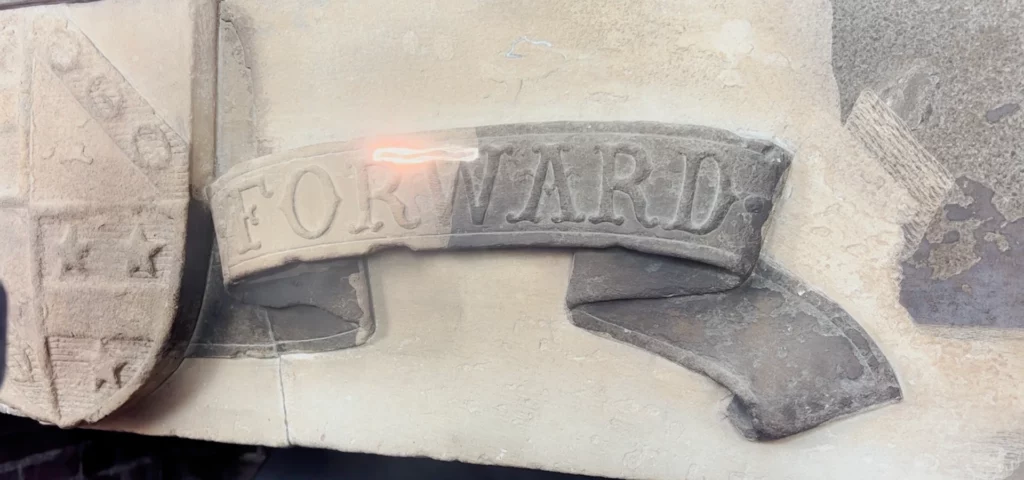
On limestone, sandstone, marble and carved detail, laser cleaning removes soot, carbon crust, paint and graffiti without wearing away the surface underneath. That’s the central advantage and it’s a real one.
The risk isn’t erosion. It’s colour. Stone can lighten, brighten or take on a colour shift once the crust comes off, and how much depends on the stone, the soiling and the laser setup. That’s why a test panel isn’t optional on this kind of work.
Why stone behaves differently from metal
On steel, the gap between the energy that lifts the contamination and the energy that affects the substrate is wide. There’s room to work in.
Stone narrows that gap in a few ways.
→ It’s porous. Soiling doesn’t just sit on top, it sits in the surface, so removing all of it means working at the surface rather than above it.
→ It’s the finish. On a steel beam nobody minds how it looks underneath. On carved stonework, appearance is the whole point of the job.
→ Colour response varies between stones, and sometimes between blocks from the same quarry, depending on weathering and previous treatment.
So the question on stone isn’t really whether you can remove the crust. It’s what the surface looks like afterwards.
The yellowing question
This is the one conservation professionals ask about and it deserves a straight answer.
Laser cleaning of blackened crust on some stones can leave the cleaned surface looking yellow or noticeably lighter than expected. It’s been observed and discussed in conservation work for years, and the causes are debated, involving the residue left behind, the composition of the crust and the response of the stone itself.
What matters practically is this. It doesn’t happen on every stone or every job, it’s influenced by the laser and how it’s set up, and it’s the single strongest reason to test before committing. If you’re cleaning a facade and only part of it, a yellow shift you didn’t expect is a serious problem.
Anyone quoting for laser cleaning on historic stone who hasn’t raised this with you is either inexperienced or hoping you won’t ask.
Limestone, sandstone and marble
They aren’t interchangeable.
→ Limestone is the most common on UK heritage work and generally responds well, though it’s also where colour shift is most discussed. Weathered limestone with heavy carbon crust is the classic laser job and also the one that most needs a test.
→ Sandstone varies enormously depending on its binder and iron content. Some sandstones clean beautifully. Others change colour readily and the iron-rich ones can behave unpredictably.
→ Marble is more sensitive again. It’s polished or finely worked in most applications, so any surface change shows immediately and the tolerance for getting it wrong is much smaller.
Previous treatment matters as much as the stone type. Old consolidants, water repellents, paint residue or earlier cleaning attempts all change how the surface responds and they’re often invisible until you start.
Carved and moulded detail
This is where laser earns its reputation on heritage work.
Abrasive methods remove material. On a flat ashlar block that might be acceptable. On a carved capital, a moulded string course or a weathered inscription, removing material means losing the thing you’re trying to save, and once a profile is softened it can’t be put back.
A laser removes the contamination rather than the substrate, so the profile survives. That’s why it’s frequently the method conservation officers will accept on carved work when abrasive cleaning has been refused and why it turns up in specifications on listed buildings.
It doesn’t make laser automatically the right answer on every historic surface. It makes it the method that doesn’t cost you the detail.
The test panel is the job
On heritage stone, the test panel isn’t a formality to get through before the real work. It’s the part that determines whether the real work happens at all.
What it should involve:
→ A representative area, not a convenient one. Test where the soiling is heaviest and on the stone type you’re most worried about. A clean result on the easiest patch tells you very little.
→ More than one panel where the stone varies. A facade with different stones, different exposures or different repair phases needs testing across them.
→ Proper documentation. Photographs before and after, in consistent light, recorded against location. On listed work this is usually what the conservation officer wants to see before approving the approach.
→ Time to assess it properly. Some surfaces look different once they’ve dried out and weathered for a few days. Judging a wet test panel an hour after cleaning isn’t a fair assessment.
→ An honest verdict. The panel exists to tell you whether to proceed. If the answer is no, that’s the panel doing its job.
When laser isn’t the right answer on stone
→ When the test panel shows a colour change the client or conservation officer won’t accept.
→ When the stone is already friable or delaminating, where the surface itself is failing and cleaning it risks losing material regardless of method.
→ When the soiling has penetrated deeper than a surface treatment can reach and no cleaning method is going to give the result being hoped for.
→ When the honest answer is that the building would be better left as it is. Not every blackened facade needs cleaning, and patina isn’t always dirt.
The bottom line
On carved and delicate stone, laser cleaning protects the detail in a way abrasive methods can’t. That’s genuinely why it gets specified on listed work.
What it doesn’t do is guarantee the colour outcome, and the honest version is that the stone decides that as much as we do. The test panel is how you find out before it matters rather than after.
→ More on our heritage conservation work.
If you’ve got a stone facade or carved detail you’re weighing up, the quickest way to know is a test panel. Book a demo with our team and we’ll show you the result on your own stone before anything is committed.